Dr. Karen Soh & Dr. JC Heng | Restoring Confidence Through Hair Health at AURA Trichocare
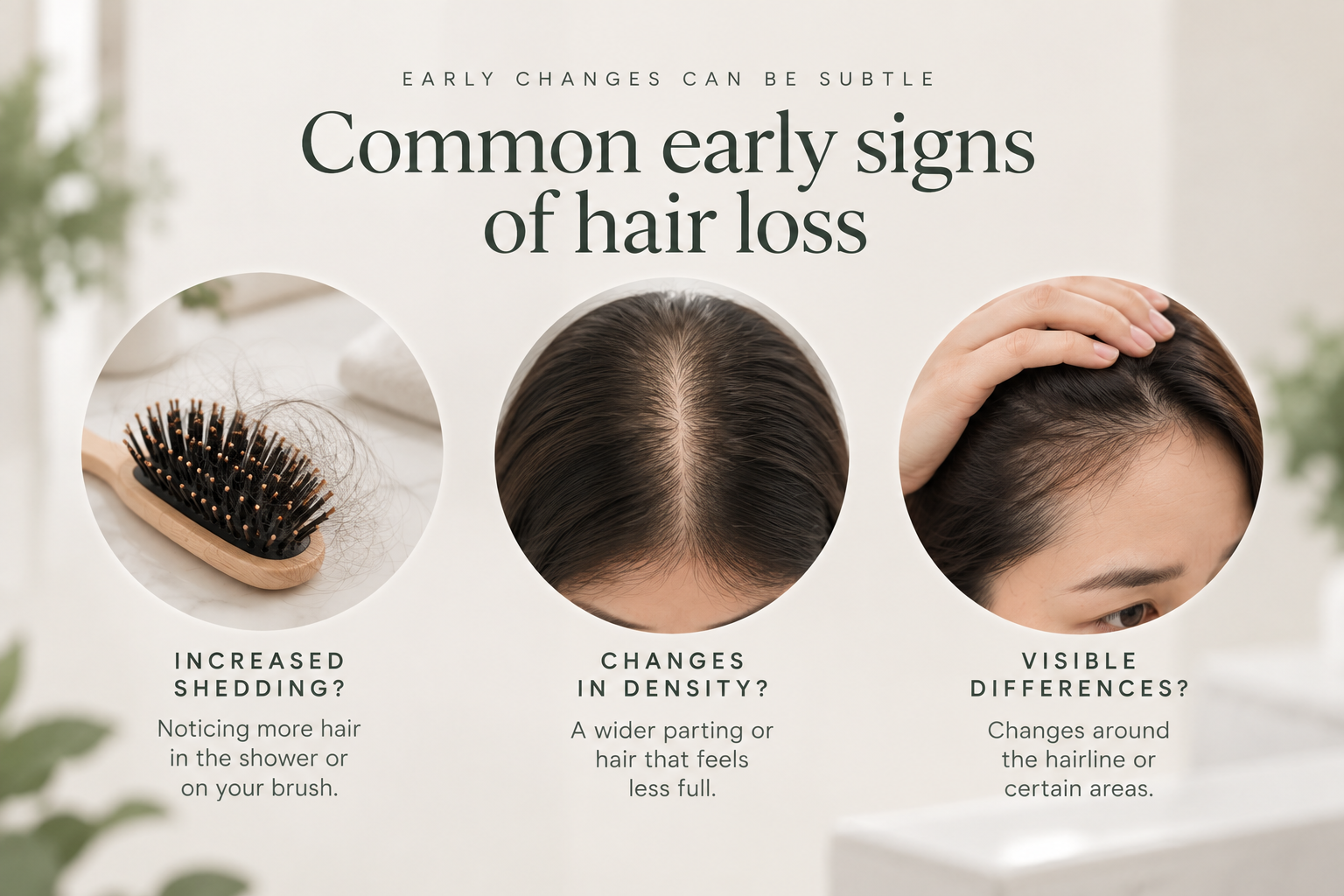
Hair loss can be a deeply personal concern. For some, it begins with noticing more hair in the shower. For others, it may be a gradual change in density, volume or the appearance of the hair over time.
Whatever the concern, hair restoration should not begin by simply asking:
“Which treatment should I do?”
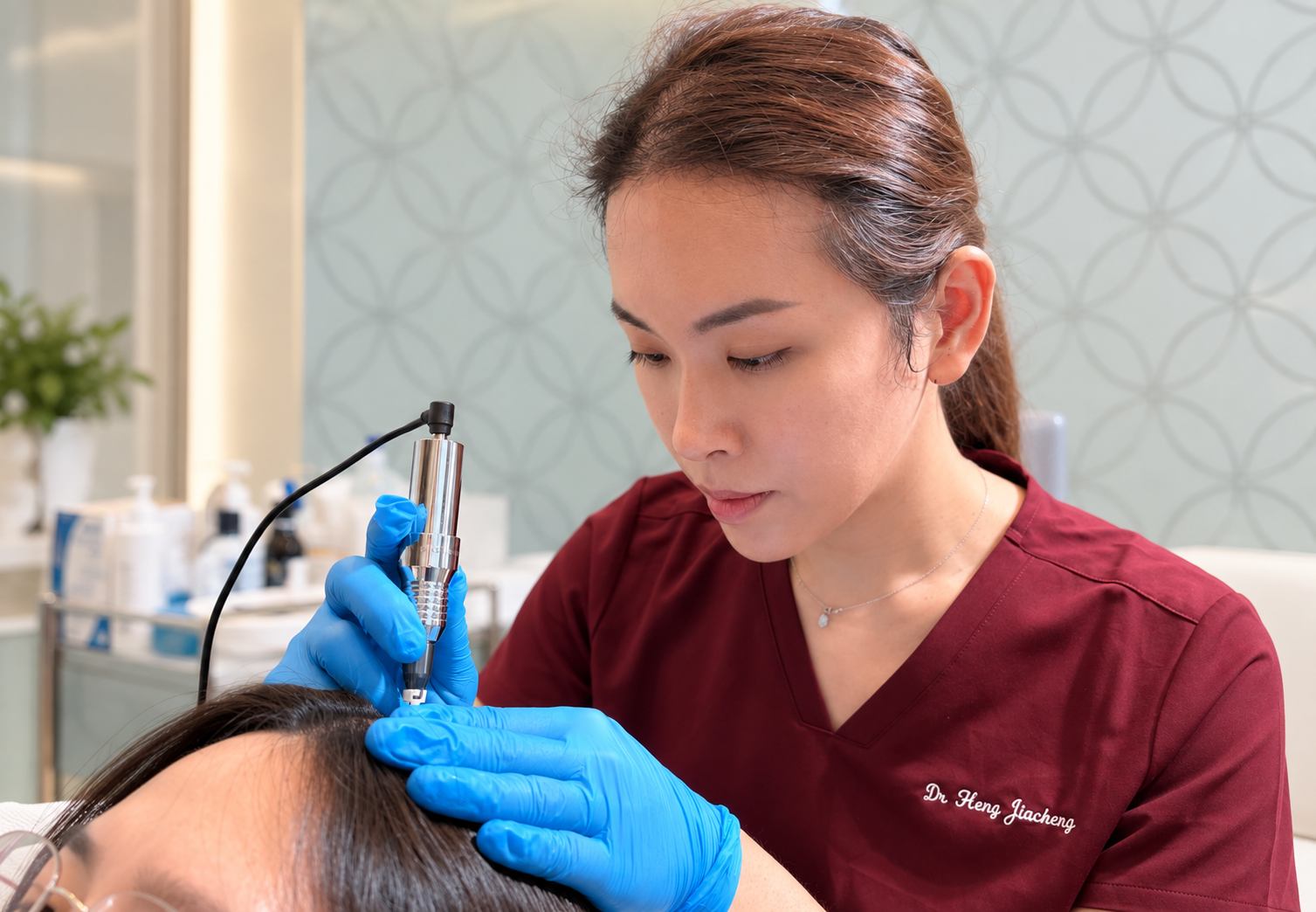
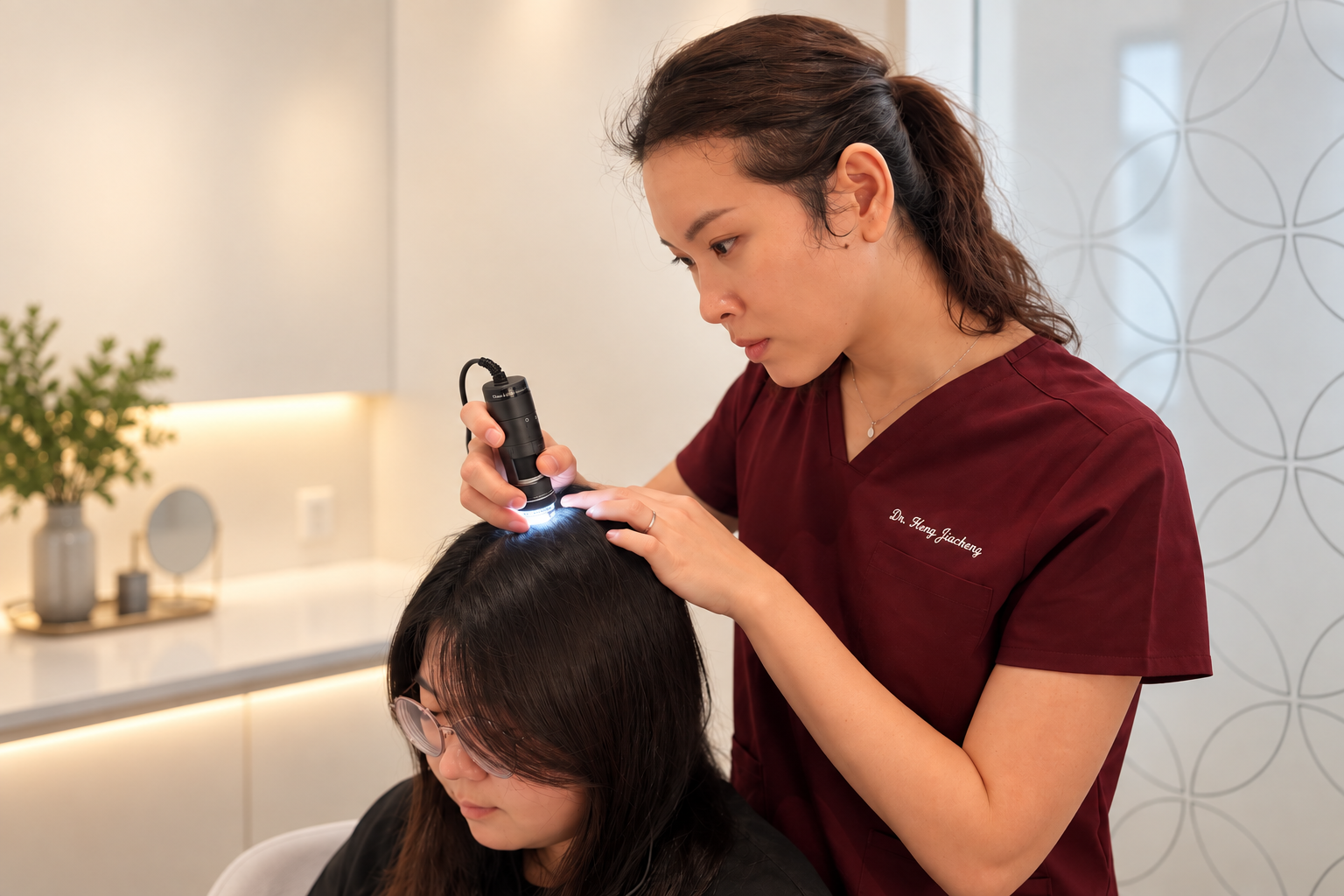
At AURA Trichocare, Dr. Karen Soh and Dr. JC Heng take a doctor-led approach that starts with understanding the individual, assessing the hair and scalp, and considering what may be contributing to the concern before developing a treatment plan.
The philosophy is straightforward:
Understand the cause. Treat appropriately. Review the progress. Plan for the long term.
Because meaningful hair restoration is not simply about choosing a treatment. It is about making informed decisions based on the individual and supporting healthier hair over time.
Doctor-led hair restoration means that medical assessment and clinical decision-making form the foundation of the patient’s hair restoration journey.
Rather than applying the same solution to everyone experiencing hair loss, the process begins by understanding the individual concern.
A doctor may consider the pattern and progression of hair changes, the condition of the scalp, relevant medical history, previous treatments and other factors before deciding what approach may be appropriate.
This matters because hair loss is not one single condition.
Different patients can experience similar-looking hair concerns for different reasons. As a result, a treatment that may be appropriate for one person may not necessarily be appropriate for another.
At AURA Trichocare, treatment decisions are therefore guided by assessment rather than by a predetermined treatment plan.
When someone notices hair loss, the natural reaction may be to search for something that can stop the shedding or help the hair grow back.
But before considering treatment, there is a more important question:
What may be contributing to the hair loss?
Hair changes can occur for different reasons, and sometimes more than one factor may be involved.
Understanding the possible cause helps doctors determine what the treatment plan should actually be trying to address.
Without this step, patients may find themselves moving from one product or treatment to another without knowing whether those approaches are relevant to their condition.
For AURA Trichocare, identifying and understanding the concern is therefore an important starting point for personalised hair restoration planning.
Hair loss is sometimes easy to dismiss in its earlier stages.
Patients may wait for the condition to improve on its own or only seek help when changes become more noticeable.
However, different forms of hair loss can behave differently over time.
Early assessment gives doctors an opportunity to establish what is happening, monitor changes and determine whether intervention may be appropriate.
It does not mean that every patient who notices increased shedding requires immediate treatment.
Instead, early assessment is about gaining clarity.
It can help answer questions such as:
Is this change within an expected range?
Is the hair loss progressing?
Does the pattern suggest that further assessment may be useful?
Should the condition be monitored?
Is treatment appropriate at this stage?
In hair restoration, understanding the starting point can be important when planning what comes next.
Hair restoration is not only about the strands of hair that we see.
The scalp is also part of the overall assessment.
Changes in the scalp may occur alongside hair concerns, and evaluating scalp health can provide doctors with additional information when considering the patient’s overall condition.
At AURA Trichocare, the hair and scalp are therefore not viewed as completely separate concerns.
The objective is not to assume that every hair-loss problem begins with the scalp, but to consider scalp health as part of a broader assessment where relevant.
This helps create a more complete understanding of the patient’s hair health before a management plan is developed.
There is a vast amount of information surrounding hair loss, ranging from supplements and shampoos to treatments, technologies and advice shared online.
This can make it difficult for patients to know what is relevant to them.
An evidence-based approach means treatment decisions are guided by established medical knowledge and available clinical evidence, together with the doctor’s assessment of the individual patient.
It also means recognising that a treatment being popular does not automatically make it suitable for everyone.
Before recommending an approach, doctors should be able to consider:
What are we treating?
Why are we considering this approach?
Is it appropriate for this patient?
What can it realistically achieve?
What are its limitations and considerations?
Evidence provides the foundation.
Clinical assessment helps determine how that evidence applies to the individual.
One of the most common questions patients ask is:
“What is the best treatment for hair loss?”
But there is no single treatment that is best for every person experiencing hair loss.
Hair concerns can differ in their underlying cause, pattern, duration and severity. Patients also differ in their medical history, lifestyle, treatment preferences and expectations.
This is why personalised treatment planning matters.
Instead of asking which treatment is universally “best”, a more useful question is:
“Which approach may be appropriate for my particular hair concern?”
The answer should come from understanding the patient and the condition rather than simply selecting the most popular option.
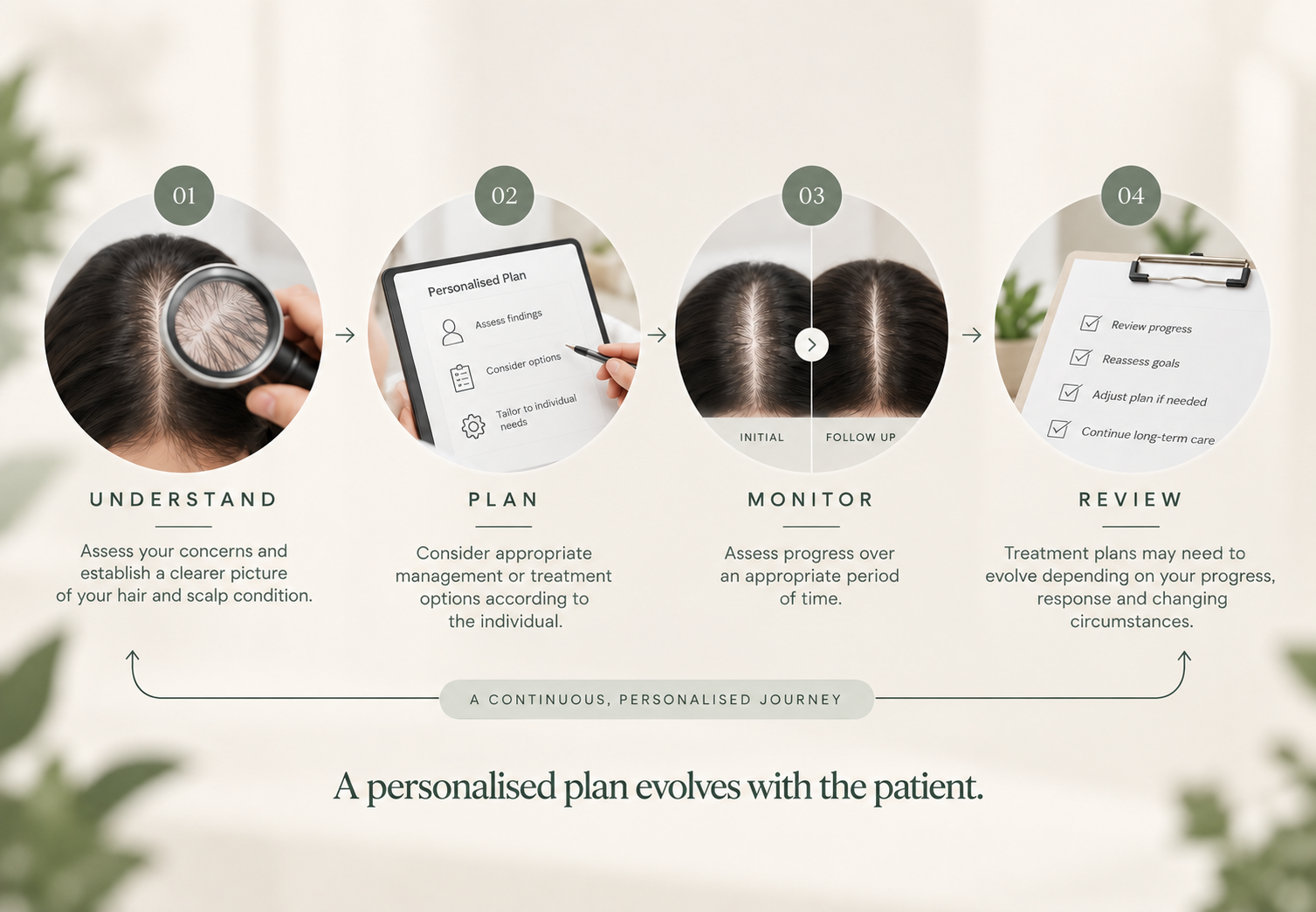
A personalised hair restoration plan should have a clear purpose.
At AURA Trichocare, the process can be understood through four principles:
This creates a more structured approach than simply repeating treatments without reviewing whether they remain appropriate.
Hair restoration is different from treatments where changes may be evaluated immediately.
Hair follows a biological growth cycle, and visible changes in hair growth and density can take time.
This is why realistic expectations are important.
Patients should understand that the timeframe for assessing progress can vary depending on their condition and management plan.
A doctor-led approach therefore looks beyond immediate results and considers how the patient’s hair health should be monitored over time.
This also helps patients avoid constantly switching between treatments simply because they do not see an immediate change.
For some patients, hair restoration may involve more than a short course of treatment.
Depending on the individual condition, maintaining hair health may require ongoing monitoring, reassessment or management.
Long-term planning does not mean that every patient will need treatment indefinitely.
Instead, it means thinking beyond the first treatment session.
A longer-term plan may consider:
The patient's starting condition
The objective of treatment
How progress will be evaluated
Whether the treatment is achieving its intended purpose
Whether adjustments may be needed
Whether maintenance may be appropriate
Whether the patient's circumstances have changed
This creates continuity in the patient’s hair-health journey.
A good hair restoration journey should begin with realistic expectations.
Not every type of hair loss behaves in the same way, and not every patient responds in the same way.
Treatment may aim to support different objectives depending on the individual condition.
For this reason, patients should understand what the treatment is intended to achieve, how long it may take before progress can reasonably be evaluated and whether ongoing management may be necessary.
Hair restoration is therefore better viewed as a process rather than a single procedure.
The goal is not simply to “do more”.
It is to make appropriate decisions at each stage of the journey.
Hair loss can affect how people feel about themselves, but meaningful hair restoration should begin with more than the promise of hair growth.
It should begin with understanding.
At AURA Trichocare, Dr. Karen Soh and Dr. JC Heng take a doctor-led approach centred on assessment, early identification of hair concerns, scalp health, evidence-based decision-making and personalised long-term planning.
Meet Your AURA Doctors | Dr. Karen Soh & Dr. JC Heng
Restoring Confidence Through Hair Health
Speak with the AURA Trichocare team to understand your hair and scalp concerns and discuss whether further assessment or treatment may be appropriate for you.
Hair-loss causes, treatment suitability, response and outcomes vary between individuals. Treatment recommendations are subject to medical consultation and individual assessment.
Doctor-led hair restoration is an approach in which medical assessment, diagnosis and clinical decision-making guide the management of hair-loss concerns. Treatment is considered according to the individual’s condition rather than applying the same solution to every patient.
Different types of hair loss can have different contributing factors and may require different management approaches. Assessment helps establish what may be happening before treatment options are considered.
No. There is no single hair-loss treatment that is best for everyone. The appropriate approach depends on the individual’s condition, possible contributing factors, medical suitability and treatment goals.
Early assessment can help establish the patient’s current condition, identify whether changes are progressing and determine whether monitoring, further evaluation or treatment may be appropriate.
The scalp forms part of the environment in which hair grows, and scalp changes may sometimes occur alongside hair concerns. Assessing the scalp where relevant can help doctors develop a more complete understanding of the patient’s hair health.
Evidence-based hair restoration means using established medical knowledge and clinical evidence to guide treatment decisions, while considering the individual patient’s condition and suitability.
Hair grows through biological cycles, so visible changes generally need to be assessed over time. The appropriate timeframe varies according to the condition, treatment approach and individual response.
Hair conditions and treatment responses can change over time. Reviewing progress allows doctors to determine whether the existing approach remains appropriate or whether the plan should be adjusted.
Embrace your journey to beauty with AURA,
where your unique aura is celebrated and empowered.
Let us unveil your most beautiful self.
Seek subtle enhancements or extensive transformations? We’ll help you feel confident and empowered in your own skin. Speak to our experienced specialists to discover the best treatment plan for you.
Your journey begins here.
Join our newsletter
for expert insights on beauty.