TREATMENTS 27 MAR 2026

Menopause and Hair Loss: Understanding the Hormonal Connection

Menopause and Hair Loss: Understanding the Hormonal Connection

Menopause typically occurs in a woman’s late 40s to early 50s and marks the end of reproductive years. During this transition, significant hormonal changes take place – many of which can affect hair health.

Hair thinning during menopause is common, but understanding why it happens helps guide appropriate treatment.


The Stages of Menopause


The menopausal transition occurs in three stages:

Perimenopause

This is the transitional phase leading up to menopause. Hormone levels fluctuate significantly and irregular menstrual cycles are common. It usually begins in a woman’s 40s and may last up to 10 years. Hair shedding and changes in texture may begin during this phase.

Menopause

Menopause is diagnosed after 12 consecutive months without a menstrual period.

Post-Menopause

This stage continues for the remainder of life. Hormone levels stabilise at lower levels, and long-term effects such as hair thinning may become more noticeable.


Why Does Hair Loss Occur During Menopause?


The primary driver of menopausal hair loss is hormonal decline – particularly estrogen and progesterone.


Decrease in Estrogen

Estrogen plays an important role in maintaining the anagen (growth) phase of the hair cycle. When estrogen levels decline:

  • The growth phase becomes shorter

  • More hairs enter the resting (telogen) phase

  • Shedding increases

  • Overall density gradually reduces

Hair may feel thinner, finer, and less voluminous.


Decrease in Progesterone

Progesterone also plays a protective role in hair biology.

It helps regulate hair growth by:

  • Suppressing luteinising hormone (LH), which influences androgen production

  • Inhibiting the 5-alpha reductase enzyme, which converts testosterone into dihydrotestosterone (DHT)

DHT is a potent androgen associated with follicle miniaturisation.

When progesterone declines, this protective effect weakens, allowing hair follicles to become more susceptible to DHT – especially in genetically predisposed individuals.


Relative Increase in Androgen Activity

Testosterone levels do not typically rise during menopause. However, because estrogen and progesterone decline, there is a relative increase in androgen influence.

This hormonal shift makes follicles more sensitive to DHT, leading to gradual miniaturisation — the hallmark of female-pattern hair loss.


How Common Is Menopausal Hair Loss?

Female-pattern hair loss becomes significantly more common after menopause.

Studies suggest that over half of postmenopausal women experience some degree of thinning, with severity increasing with age and time since menopause.

Unlike male pattern baldness, women usually experience:

  • Diffuse thinning

  • Widening of the central part

  • Reduced density rather than complete bald patches

Is Hormone Replacement Therapy (HRT) a Solution?


Hormone replacement therapy is not routinely recommended solely for hair loss.

While estrogen replacement may influence hair growth, HRT carries systemic risks and benefits that must be carefully weighed.

It may be discussed in the broader context of menopausal symptom management, but it is not considered a primary treatment for hair loss alone.


Treatment Approach for Menopausal Hair Loss


Management should always be individualised.


Initial Assessment

A thorough evaluation typically includes:

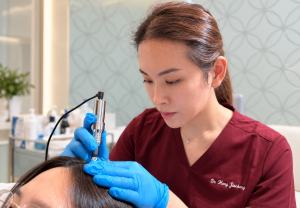
  • Clinical scalp examination

  • Trichoscopy

  • Baseline blood tests

Correcting nutritional deficiencies is an essential first step.


Medical Therapy

Depending on the pattern and severity of thinning, treatment options may include:


Antiandrogen Therapy

For patients with signs of androgen sensitivity:

  • Spironolactone

  • Finasteride

These medications reduce the effect of DHT on hair follicles.


Minoxidil

  • Topical minoxidil

  • Oral low-dose minoxidil

Minoxidil stimulates follicle activity and prolongs the growth phase.


Nutraceutical Support

In milder cases, or for patients who prefer to avoid medication, nutraceuticals may be considered.

However, they are generally adjunctive rather than standalone treatments.


Adjunctive Therapies

Additional treatments that may complement medical therapy include:

  • Low-level laser therapy (LLLT)

  • Regenera Activa

  • Potenza microneedling

These modalities aim to stimulate follicular activity and improve the scalp environment.


Final Thoughts


Hair thinning during menopause is common and largely hormonally driven.

While the decline in estrogen and progesterone cannot be prevented, the impact on hair can often be managed effectively with early intervention.

The key is personalised assessment and targeted treatment.

If you are experiencing increased shedding or thinning during perimenopause or post-menopause, a comprehensive evaluation allows us to determine whether it is temporary shedding or developing female-pattern hair loss — and to tailor a plan accordingly.

Latest Posts
Female Pattern Baldness: Causes, Symptoms, and Effective Treatments
Male Pattern Baldness: Causes, Stages and Treatments
Patchy Hair Loss: Causes, Symptoms and Treatment Options
Dutasteride Injections: What Patients Should Know About This Off-Label Hair Loss Approach
References Saceda-Corralo D, Moustafa F, Moreno-Arrones Ó, et al.Mesotherapy With…
Semaglutide for Weight Loss; Everything You Need to Know
Understanding How HIFU and RF Affect Facial Fat: Risks, Benefits, and Differences
Menopause and Hair Loss: Understanding the Hormonal Connection
Hair Shedding vs Hair Loss: When Should You Be Concerned?
Scarring Alopecia: What It Is, Types, and How to Treat It
Hair Transplant Aftercare: Essential Tips for Faster Healing and Optimal Results
Types of Hair Transplant for Men and Women
Common Reasons Why Your Scalp Itches and How to Find Relief
Best HydraFacial Experience in Singapore at AURA Medical Aesthetics
Overseas vs. Singapore: Considerations for Aesthetic Treatments 
Tweakment Timeline: Aesthetic Treatments Guide from 20s to 60s in Singapore
Hyaluronic Acid vs. Biostimulatory Fillers in Singapore: A Comparison Guide
Pico Laser Treatment Price: Why Costs Vary Between Clinics?
How Pico Laser Wavelengths Work: A Guide To What Each Wavelength Targets
Jaw (Masseter) Injections for Facial Slimming: What Is It & What to Expect
Ultherapy vs. HIFU vs. Thermage: What Are They & How Do They Work?
RF Microneedling vs Microneedling in Singapore: Treatments for Acne Scars and Enlarged Pores
CoolSculpting in Singapore: How It Works, Benefits, and Common Treatment Areas
Is Ultherapy Worth It If You Do Not See Results?
Stabilised Hybrid Hyaluronic Acid (HA) vs Polynucleotide (PN) vs Other Skin Boosters: Which Is Better?
What Is Pico Laser? A Guide to the Technology, Its Benefits and Uses
Ultherapy: Development, Approved Uses,  Alternatives & FAQs
Anti-Wrinkles Injections: What It Is, Brand Types, and 6 Benefits

Embrace your journey to beauty with AURA,
where your unique aura is celebrated and empowered.
Let us unveil your most beautiful self.

Seek subtle enhancements or extensive transformations? We’ll help you feel confident and empowered in your own skin. Speak to our experienced specialists to discover the best treatment plan for you.
Your journey begins here.

    Join our newsletter
    for expert insights on beauty.