Scarring alopecia refers to a group of conditions that cause permanent destruction of hair follicles. The follicles are replaced by fibrous tissue, resulting in irreversible hair loss.
Unlike common forms of hair loss where follicles are miniaturised but still present, scarring alopecia involves true follicular destruction. Once scarring has occurred, regrowth is no longer possible.
The underlying mechanism is typically an inflammatory process targeting the follicle.
Primary scarring alopecia occurs when inflammation directly targets the hair follicle. These are broadly classified based on the dominant inflammatory cell type.
Lymphocytic Types
Lichen Planopilaris (LPP)
Lichen planopilaris is one of the more commonly encountered forms.
Features include:
Progressive hair loss
Perifollicular erythema
Perifollicular hyperkeratosis
Itching, burning, or scalp tenderness
Diagnosis requires a scalp biopsy demonstrating a lymphocytic inflammatory pattern consistent with LPP.
Important concepts:
There is no cure for LPP.
The disease course is unpredictable.
Treatment aims to halt progression.
Regrowth in scarred areas is unlikely.
Frontal Fibrosing Alopecia (FFA)
FFA is considered a subtype of LPP.
It typically presents as:
A band-like recession of the frontal hairline
Sparing of isolated hairs within the receded area (“lonely hair” sign)
Loss of eyebrows in some cases
There is a statistically significant association between FFA and sunscreen use, although causality has not been established.
Discoid Lupus Erythematosus (DLE)
DLE is a cutaneous form of systemic lupus erythematosus.
It presents with:
Well-demarcated inflammatory plaques
Scaling and erythema
Progression to atrophic scarring
Central Centrifugal Cicatricial Alopecia (CCCA)
CCCA primarily affects women of African descent.
It typically begins at the crown and spreads centrifugally toward the parietal areas.
Symptoms may include:
Itching
Tenderness
Prickling sensations
Over time, hypopigmentation, hyperpigmentation, and extensive scarring may develop.
Less Common Lymphocytic Types
Graham-Little-Piccardi-Lasseur syndrome
Keratosis follicularis spinulosa decalvans
Neutrophilic Types
These forms are often pustular or infection-driven.
Examples include:
Folliculitis decalvans
Dissecting cellulitis of the scalp
Mixed Types
These show both lymphocytic and neutrophilic features.
Examples include:
Acne keloidalis nuchae
Acne necrotica
Erosive pustular dermatitis of the scalp
Secondary Scarring Alopecia
Secondary forms occur when follicles are destroyed by external factors rather than primary inflammatory disease.
Causes include:
Burns
Radiation
Severe infections
Trauma
Clinical History
A detailed history is essential. Symptoms such as pain, burning, or rapid progression may suggest active inflammation.
Scarring alopecia often presents with:
Irreversible hair loss
Scalp itching, burning, tenderness, or pain
Visible signs of inflammation
Common clinical signs include:
Erythema
Scale
Pustules
Atrophic plaques
Patterns vary depending on the specific subtype.
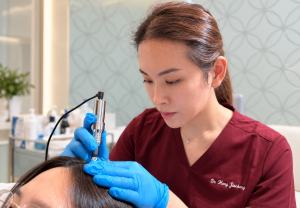
Trichoscopy
Trichoscopy is crucial in evaluation.
Common findings include:
Loss of follicular ostia
Perifollicular erythema
Perifollicular hyperkeratosis
These findings strongly suggest scarring alopecia.
Scalp Biopsy
A scalp biopsy is required to confirm the diagnosis and determine the inflammatory subtype.
Accurate diagnosis is essential because treatment varies significantly depending on the condition.
The primary goal of treatment is to halt disease progression and preserve remaining hair.
Early intervention is critical because established scarring is irreversible.
Treatment depends entirely on the underlying diagnosis.
Lichen Planopilaris
First-line:
High-potency topical corticosteroids
Intralesional corticosteroids
Second-line:
Oral prednisolone
Hydroxychloroquine
Frontal Fibrosing Alopecia
Management may include:
Topical tacrolimus
Clobetasol
Minoxidil twice daily
Intralesional corticosteroids
5-alpha reductase inhibitors (finasteride or dutasteride)
Hydroxychloroquine
Doxycycline
Methotrexate in resistant cases
Acne Keloidalis Nuchae
Oral doxycycline
Topical corticosteroids
Topical retinoids
Dissecting Cellulitis
Treatment focuses on controlling active infection:
Culture-guided systemic antibiotics
Anti-inflammatory therapy
Treatment varies significantly between subtypes. Establishing the correct diagnosis is the most important step.
Hair transplantation in scarring alopecia remains a complex and controversial topic.
In my view, transplantation should only be considered when the underlying inflammatory process is fully quiescent.
Active disease significantly increases the risk of:
Poor graft survival
Disease reactivation
Ideal candidates should demonstrate:
No clinical signs of active inflammation
Biopsy-confirmed absence of ongoing inflammation
A cautious approach involves performing a small trial transplant to assess graft survival before planning a larger procedure. Patient selection and disease stability are critical to achieving acceptable outcomes.
Embrace your journey to beauty with AURA,
where your unique aura is celebrated and empowered.
Let us unveil your most beautiful self.
Seek subtle enhancements or extensive transformations? We’ll help you feel confident and empowered in your own skin. Speak to our experienced specialists to discover the best treatment plan for you.
Your journey begins here.
Join our newsletter
for expert insights on beauty.