TREATMENTS 21 July 2026

Female Pattern Baldness: Causes, Symptoms, and Effective Treatments

Female Pattern Baldness: Causes, Symptoms, and Effective Treatments

This thinning typically begins along the part line. It affects approximately 12% of women in their late 20s, with prevalence increasing with age – around 25% by the late 40s, 41% by the late 60s, and over 50% in women aged 80 and above.

At AURA, treatments for female pattern hair loss are tailored to the individual. They’re designed to help slow further loss, strengthen existing hair and support regrowth where possible.

What Is Female Pattern Baldness?

Female pattern baldness, also known as androgenetic alopecia or female pattern hair loss (FPHL), is a progressive hair loss, characterised by gradual thinning along the part line. It’s also often accompanied by reduced hair density at the top of the head.

It’s commonly influenced by genetics, although hormonal changes can also play a role (i.e., especially after menopause). As the condition progresses, the scalp may become more visible due to reduced hair coverage.

Regrowth may be more limited once hair follicles become significantly miniaturised. For this reason, early and consistent management can help slow progression and support hair retention where possible.

What Causes Female Pattern Baldness?

Common triggers for hair loss in women may include one or a combination of the following:


Genetic Factors


A family history of pattern hair loss is one of the key contributing factors to female pattern baldness. In a case-control study by Jungyoon Ohn et al. (2022), 71.4% of patients with early-onset female pattern hair loss reported a positive family history of the condition.


Hormonal Changes


Declining oestrogen and progesterone can contribute to hair thinning. These hormonal imbalances, particularly after menopause, may lead to follicular miniaturisation, where hair follicles shrink and produce thinner, shorter strands. In certain conditions, such as PCOS, an elevated testosterone level can also result in early-onset hair thinning.


Age-Related Hair Follicles Changes


Ageing often brings changes to hair follicles. Follicles may start producing less hair than before, leading to reduced hair density. Hair may also spend a longer time in the resting or telogen phase, causing increased shedding and slower replacement of lost strands.


Nutritional Deficiencies


Deficiencies in protein, iron, zinc, and vitamins A, C, D, and E may contribute to hair thinning and increased shedding. These nutrients play important roles in maintaining healthy hair growth and supporting normal follicle function.

Protein is essential for the production of keratin, the primary structural component of hair, while iron helps deliver oxygen to hair follicles. Zinc supports tissue growth and repair, including the healthy functioning of hair follicles.

Vitamins A, C, D, and E also contribute to scalp and follicle health, supporting processes such as cell turnover, collagen production, and protection against oxidative stress.


High Stress Level


Stress can contribute to female pattern baldness in several ways. Primarily, it may push hair follicles into the resting phase, causing increased shedding that becomes noticeable months later. Elevated cortisol levels from stress may also disrupt the healthy hair growth cycle.

Additionally, stress also often triggers immune-related responses that affect hair follicles, potentially contributing to conditions such as alopecia areata. In some individuals, stress can also be associated with habitual hair pulling, known as trichotillomania.


Medical Condition


Certain medical conditions, such as thyroid disorders, autoimmune disorders, or Polycystic Ovary Syndrome, may trigger hair loss in females. Most cases result from affected hormone levels, impaired nutrient absorption, or disruption of the normal hair growth cycle.

Not all hair loss from medical conditions is permanent. It helps to speak with your doctor and identify the underlying factors early, so you can receive more appropriate care and management for your condition.

Symptoms of Female Pattern Baldness

There are several symptoms that specialists use to evaluate female pattern baldness, including:

  • Gradual Hair Thinning

    Gradual thinning is often one of the earliest signs of female pattern hair loss. Many women may not notice the changes at first, as the thinning develops progressively and may only become noticeable once hair density is visibly reduced over time.

  • Diffuse Hair Loss on the Crown

    Unlike male pattern baldness, female pattern hair loss typically presents as diffuse thinning over the crown and top of the scalp. The thinning usually affects the central part line rather than the frontal hairline, gradually widening and extending to both sides over time.

  • Reduced Hair Volume

    Hair volume may gradually decrease as individual strands become finer and hair density reduces over time. Many women notice that their ponytail feels thinner, their hairstyles appear flatter, or their scalp becomes more visible under bright lighting.

Stages of Female Pattern Baldness

Classification systems such as the Ludwig Scale and the Savin Scale can help assess the extent of hair loss in women. Specialists may use either of these scales to monitor changes over time and guide appropriate management approaches.

Ludwig Scale

The Ludwig Scale is one of the most widely used systems for classifying female pattern hair loss. It focuses on the degree of thinning over the crown and the central part line.

  • Stage I: Early Thinning

    • Mild thinning begins around the central part line
    • Hair density remains relatively preserved
    • Scalp visibility is usually minimal
  • Stage II: Moderate Thinning

    • The widening of the part line becomes more noticeable
    • Diffuse thinning extends across the top of the scalp
    • Reduced hair volume becomes increasingly visible
  • Stage III: Advanced Thinning

    • Significant reduction in hair density at the crown
    • Scalp visibility becomes prominent
    • Hair coverage over the top of the scalp is considerably reduced

Savin Scale

The Savin Scale is a more detailed classification system adapted from the Ludwig Scale. It evaluates both the degree of thinning and the extent of frontal hairline involvement.


Note that these classifications serve only as clinical references and not as definitive indicators of treatment outcomes or hair regrowth potential. Proper assessment remains important to understand the pattern, severity and progression of hair loss in each individual.

How Female Pattern Baldness is Diagnosed

As hair thinning can occur for many reasons, specialists evaluate multiple contributing factors to diagnose female pattern baldness in women. Here are some of the common assessments used to identify the condition and evaluate its progression.

  • Medical History Review

    A specialist may review your medical history, including family history of hair loss, hormonal changes, medications, stress levels, nutritional status, and existing medical conditions that may contribute to thinning.

  • Scalp Examination

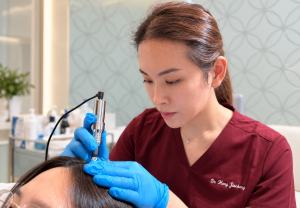
    The scalp and hair are examined to assess hair density, thinning patterns, scalp condition, and follicle health. Female pattern hair loss commonly presents as diffuse thinning over the crown and widening of the central part line. Trichoscopy, or a non-invasive scalp imaging technique, may be used to examine hair follicles more closely. One common finding in female pattern hair loss is anisotrichosis, where hair strands vary significantly in diameter due to follicular miniaturisation.

  • Blood Tests for Underlying Conditions

    Blood tests may be recommended to identify possible contributing factors such as iron deficiency, thyroid disorders, hormonal imbalances, or vitamin deficiencies that may affect normal hair growth.

Treatment Options for Female Pattern Baldness

Not every case of female pattern baldness is the same. Individuals may respond differently to treatments depending on the cause and severity of hair loss.

This is why treatment approaches are tailored to the severity of thinning, underlying factors, and individual suitability. Options may include:


Topical or Oral Minoxidil


Minoxidil is one of the most commonly prescribed medications for female pattern hair loss. It may be prescribed as a topical solution, foam, or oral medication to help support hair growth and maintain hair density.

Topical minoxidil is commonly available in 2% and 5% formulations.Both the 2% and 5% solutions can support hair growth in women with female pattern hair loss, although higher concentrations may be associated with increased scalp irritation.


Hair Supplements


Hair growth supplements containing nutrients such as iron, zinc, amino acids, and vitamins may be recommended when nutritional deficiencies or inadequate intake are contributing factors to thinning.


Oral Medications for Hormonal Factors


Hormonal fluctuations and androgen sensitivity can contribute to female pattern hair loss in some women. Oral medications may be considered as part of the management approach, which includes:

Oral Contraceptive Pills (OCPs)
Certain oral contraceptive pills may be considered when hormonal fluctuations or androgen sensitivity are associated with hair loss in women.

Spironolactone
Spironolactone is an anti-androgen medication that may be prescribed to help manage hormonally influenced female pattern hair loss.

Finasteride/Dutasteride
Evidence suggests that higher-dose finasteride (2.5 – 5 mg daily) and daily dutasteride can help treat female pattern hair loss in postmenopausal women. Studies have reported improvements in hair density, hair thickness, and global photographic assessments, especially with finasteride 5 mg daily and dutasteride use.


Injectable Medications


Injectable treatments deliver active ingredients directly into the scalp to support hair and follicle health. One of the approaches used is Dutexome, which combines exosome therapy with dutasteride, copper peptides, and vitamins.

The treatment is designed to support follicle activity, reduce the effects of DHT on hair follicles, and improve overall scalp condition. It’s commonly delivered through micro-needling to enhance absorption into the scalp.


RF Microneedling — ACSE HRLV


RF microneedling with ACSE HRLV combines radiofrequency energy with controlled microneedling to support scalp and follicle health. The treatment works by stimulating natural healing responses within the scalp while enhancing delivery of regenerative ingredients into deeper skin layers.

Studies have shown that RF microneedling may help improve hair density and support healthier hair growth in individuals with patterned hair loss.


Hair Transplant


Hair transplant may be considered for suitable individuals with stable hair loss and sufficient donor hair availability. The procedure involves transplanting healthy follicles into thinning or balding areas to improve hair density and coverage.

Can Female Pattern Baldness Be Prevented?

Lifestyle changes may not fully prevent female pattern hair loss, particularly in a strong family history. However, early identification and management can help reverse hair thinning as long as treatment continues.

Maintaining overall scalp health, addressing nutritional deficiencies, managing stress, and seeking assessment early when thinning begins can also support healthier hair growth.

When to See a Doctor

Seeing a doctor helps to better understand your hair thinning, especially under the following circumstances:

  • When you experience sudden or excessive hair loss

  • When the hair loss is accompanied by symptoms such as fatigue, irregular periods, weight changes, scalp inflammation, or other systemic symptoms

  • When the progression of thinning becomes noticeably rapid

At AURA, we can perform a detailed assessment to identify possible contributing factors and recommend suitable management approaches based on your condition.

FAQs About Female Pattern Baldness

Yes, female pattern hair loss is reversible. However, it is important to understand that female pattern baldness is considered a chronic condition. There is no quick fix, and patients will require long-term management.

Female pattern hair loss can occur anytime after puberty. Clinically, we do see an earlier trend of patients presenting in their 20s. However, most women notice more visible thinning during or after menopause due to hormonal changes.

Female pattern baldness is typically long-term and progressive. Without management, thinning may gradually continue over time. Early intervention may help preserve existing hair and slow further progression where possible.

Stress may contribute to hair shedding and can worsen existing hair thinning in individuals predisposed to female pattern baldness. High stress levels may also disrupt the normal hair growth cycle, leading to increased shedding. Stress may contribute to hair shedding and can worsen existing hair thinning in individuals predisposed to female pattern baldness. High stress levels may also disrupt the normal hair growth cycle, leading to increased shedding.

There is no single best treatment for everyone, as management depends on the severity of hair loss, underlying contributing factors, medical history, and individual suitability.

Latest Posts
Female Pattern Baldness: Causes, Symptoms, and Effective Treatments
Male Pattern Baldness: Causes, Stages and Treatments
Patchy Hair Loss: Causes, Symptoms and Treatment Options
Dutasteride Injections: What Patients Should Know About This Off-Label Hair Loss Approach
References Saceda-Corralo D, Moustafa F, Moreno-Arrones Ó, et al.Mesotherapy With…
Semaglutide for Weight Loss; Everything You Need to Know
Understanding How HIFU and RF Affect Facial Fat: Risks, Benefits, and Differences
Menopause and Hair Loss: Understanding the Hormonal Connection
Hair Shedding vs Hair Loss: When Should You Be Concerned?
Scarring Alopecia: What It Is, Types, and How to Treat It
Hair Transplant Aftercare: Essential Tips for Faster Healing and Optimal Results
Types of Hair Transplant for Men and Women
Common Reasons Why Your Scalp Itches and How to Find Relief
Best HydraFacial Experience in Singapore at AURA Medical Aesthetics
Overseas vs. Singapore: Considerations for Aesthetic Treatments 
Tweakment Timeline: Aesthetic Treatments Guide from 20s to 60s in Singapore
Hyaluronic Acid vs. Biostimulatory Fillers in Singapore: A Comparison Guide
Pico Laser Treatment Price: Why Costs Vary Between Clinics?
How Pico Laser Wavelengths Work: A Guide To What Each Wavelength Targets
Jaw (Masseter) Injections for Facial Slimming: What Is It & What to Expect
Ultherapy vs. HIFU vs. Thermage: What Are They & How Do They Work?
RF Microneedling vs Microneedling in Singapore: Treatments for Acne Scars and Enlarged Pores
CoolSculpting in Singapore: How It Works, Benefits, and Common Treatment Areas
Is Ultherapy Worth It If You Do Not See Results?
Stabilised Hybrid Hyaluronic Acid (HA) vs Polynucleotide (PN) vs Other Skin Boosters: Which Is Better?
What Is Pico Laser? A Guide to the Technology, Its Benefits and Uses
Ultherapy: Development, Approved Uses,  Alternatives & FAQs
Anti-Wrinkles Injections: What It Is, Brand Types, and 6 Benefits

Embrace your journey to beauty with AURA,
where your unique aura is celebrated and empowered.
Let us unveil your most beautiful self.

Seek subtle enhancements or extensive transformations? We’ll help you feel confident and empowered in your own skin. Speak to our experienced specialists to discover the best treatment plan for you.
Your journey begins here.

    Join our newsletter
    for expert insights on beauty.