Research shows that androgenetic alopecia, more commonly known as male pattern baldness, affects around 30% of men by age 30 and nearly 50% by age 50. For some, they notice a receding hairline or thinning around the crown that becomes harder to style or conceal over time.
At AURA, we take a medical approach to male pattern baldness by identifying how far the condition has progressed and what factors may be contributing to the hair loss. With early intervention, it may be possible to slow further thinning and support healthier hair growth.
Male pattern baldness develops due to a combination of mainly genetic and hormonal factors that affect the hair follicles over time. The severity and rate of hair loss can vary from person to person.
Genetics and Family History
Hormonal Influence
Age and Hair Growth Cycle Changes
Lifestyle Factors
Underlying Medical Condition
Unlike temporary hair shedding, male pattern baldness follows a predictable pattern that becomes more noticeable as the hair growth cycle weakens over time.
Receding Hairline
Thinning Hair on the Crown
Progressive Hair Loss Over Time
At AURA, we measure the progression of hair loss using the Norwood Scale. It breaks down male pattern baldness into seven stages, providing a roadmap to help determine the most reliable intervention based on current density.
Image source: Adapted from Gupta, M., & Mysore, V. (2016). Classifications of Patterned Hair Loss: A Review (Norwood’s classification). Available on PubMed Central.
Norwood 1
At this stage, there is little to no noticeable hair loss. The hairline remains largely intact, with only minimal recession that is often considered part of a mature adult hairline.
Norwood 2
You will notice a slight, symmetrical recession around the temples, usually forming a small M shape. Some may also start to experience mild thinning at the crown of the scalp.
Norwood 3
The recession at the temples becomes deep enough to be easily seen. Additionally, a sub-category called Stage 3 Vertex involves thinning at the crown (the back of the head) while the hairline recession may still be relatively minor.
Norwood 4
Hair recession at the temples becomes more noticeable at this stage, while thinning at the crown develops into a more visible bald spot. Despite this, there is still a band of thicker hair separating the front hairline from the crown area.
Norwood 5
At stage 5 of the Norwood scale, the receding hairline and the thinning area at the crown come much closer together. Although they have not fully merged, only a thin strip of hair remains between them. Most of the top of the scalp will appear significantly bald.
Norwood 6
Stage 6 is reached when the strip of hair separating the receding hairline from the crown bald spot disappears completely, causing both areas to merge. At this stage, the entire top of the scalp is largely bald. It leaves a horseshoe-shaped ring of hair around the sides and back of the head.
Norwood 7
This is the most advanced stage. Only a thin horseshoe of hair remains around the back and sides of the head. This hair is finer than it was previously but it remains because these follicles are genetically resistant to the hormones that cause balding.
At AURA, we perform a proper assessment to determine the stage of hair loss and rule out other possible causes of excessive shedding or thinning hair.
Medical History Review
Although male pattern hairloss is largely hormonal, there are certain factors that can exacerbate the problems. During consultation we will need to assess for:
Scalp Examination with Trichoscopy
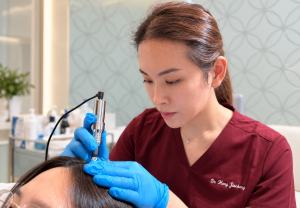
To analyse the scalp at a microscopic level, we use trichoscopy. It is a non-invasive imaging technique that magnifies the scalp and hair follicles for closer evaluation. This allows the doctor to assess hair density, follicle health and variations in hair thickness that are commonly seen in male androgenetic alopecia. Trichoscopy can also help identify whether the pattern of hair loss is consistent with male pattern baldness or other scalp condition.
Blood Tests for Underlying Conditions
In some cases, blood tests may be recommended to rule out underlying medical conditions that can contribute to hair thinning or excessive shedding. Conditions such as thyroid disorders, iron deficiency, hormonal imbalances and nutritional deficiencies may affect hair growth and scalp health. Identifying these factors helps guide a more appropriate and personalised treatment approach.
Our treatment plans are tailored based on the pattern and severity of thinning, with the aim of slowing further hair loss and supporting healthier hair growth.
Yes, with the caveat that it is picked up early. Early intervention may help slow the progression of hair thinning and preserve existing hair for a longer period of time.
Seeking treatment during the earlier stages of hair loss can provide better outcomes than waiting until the thinning becomes more advanced. Once a follicle has completely stopped producing hair for several years, it is difficult to revive.
Certain signs may indicate that the hair loss should be medically assessed.
Duration Hair Loss
Male pattern baldness typically develops over several years. If you notice a significant amount of hair falling out abruptly, such as seeing large clumps on your pillow, in the shower or when running your hands through your hair, it may indicate a condition other than genetic thinning.
Hair Loss Accompanied by Other Symptoms
Hair loss is sometimes a secondary sign of a systemic health concern. It is important to consult a professional if your thinning hair is accompanied by:
Rapid Thinning or Bald Spots
Male baldness is known for its predictable, slow recession at the temples or crown. You should seek an assessment if you observe:
Smooth, circular bald spots that appear suddenly (often a sign of alopecia areata).
Rapid thinning across the scalp within a short period
Noticeably increased hair shedding during washing, brushing or styling
Generally, male pattern baldness (androgenetic alopecia) is not fully reversible once a hair follicle has become vellus, or what is commonly known as baby hairs, However, if thinning is addressed in the early stages, treatments may help slow further thinning, preserve existing hair and support regrowth in some individuals.
Male pattern baldness can begin at different ages depending on genetics and individual factors. In theory it can occur anytime after puberty. Some men notice early signs such as a receding hairline or thinning crown in their twenties, while others may only experience noticeable hair loss later in life.
Without clinical intervention, the thinning caused by male pattern baldness is permanent and progressive. This occurs as follicles shrink due to DHT sensitivity until they can no longer produce healthy hair.
Moreover, hair loss becomes irreversible once follicles have been inactive for a prolonged period. At that stage, only surgical procedures like a hair transplant can restore growth.
Stress does not cause genetic male baldness, but it can make the symptoms appear more rapidly. High levels of physical or emotional stress can trigger a different type of shedding called telogen effluvium, which pushes more hairs into the resting phase.
There is no single treatment that works best for everyone. The most suitable approach depends on the stage of hair loss, scalp condition and individual treatment goals.
Embrace your journey to beauty with AURA,
where your unique aura is celebrated and empowered.
Let us unveil your most beautiful self.
Seek subtle enhancements or extensive transformations? We’ll help you feel confident and empowered in your own skin. Speak to our experienced specialists to discover the best treatment plan for you.
Your journey begins here.
Join our newsletter
for expert insights on beauty.